
Instead of replacing a missing tooth… could we simply grow another one?
For most of dental history, losing a tooth has meant one thing:
replace it.
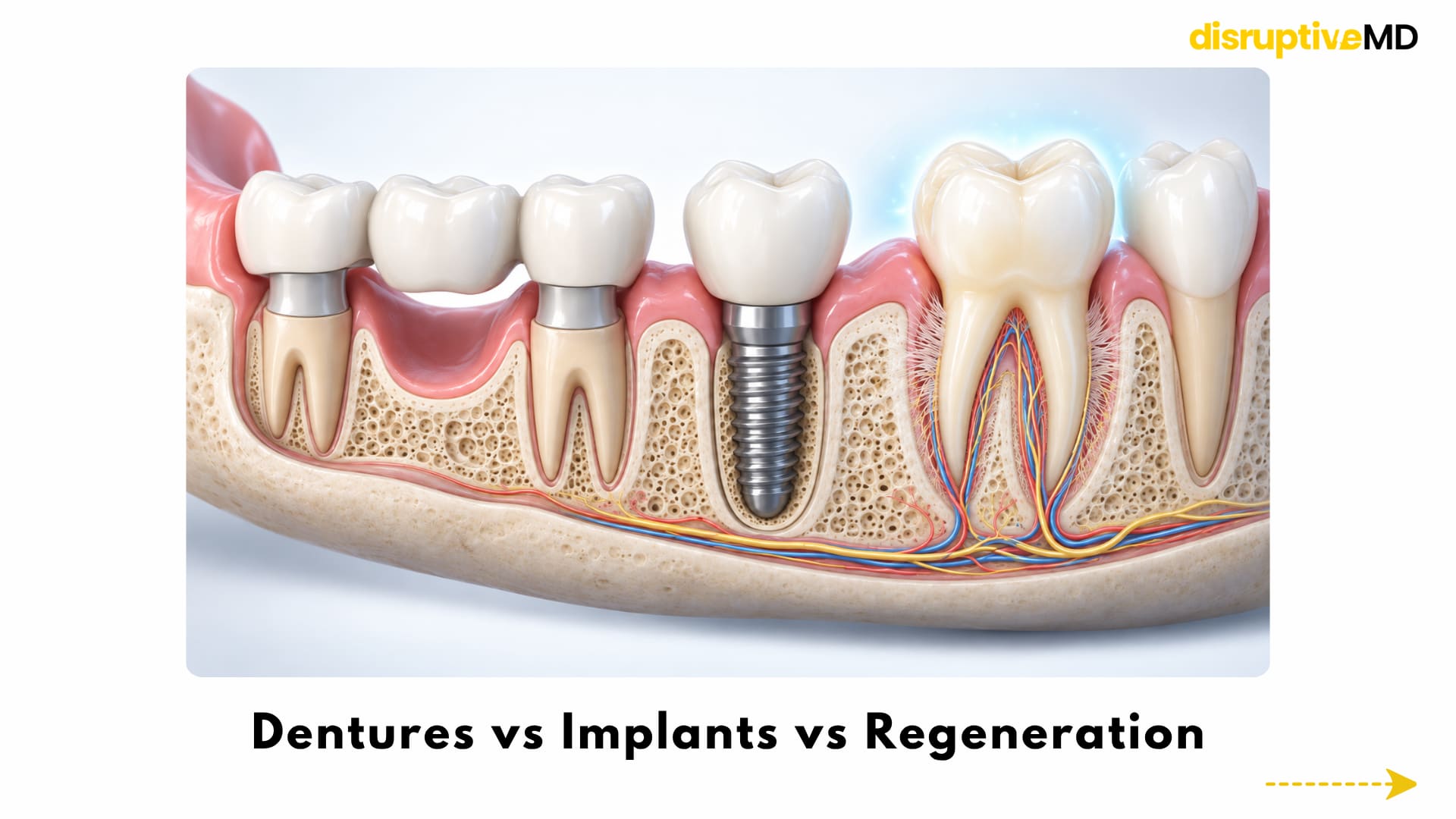
Dentures replace missing teeth with removable prosthetics.
Bridges fill the empty space using neighbouring teeth for support.
Dental implants go even further, placing an artificial root into the jawbone and attaching a prosthetic tooth on top.
Modern dentistry has become extraordinarily good at replacing what biology has lost.
But regenerative medicine is beginning to ask a much more disruptive question:
What if the next treatment for a missing tooth is not an artificial tooth at all?
What if the body could be persuaded to grow another one?
That possibility is no longer confined to science fiction.
Researchers have identified biological signals that help control how many teeth develop. They have shown in animal models that blocking one particular protein USAG-1 can rescue arrested tooth development and stimulate additional tooth formation. A humanized antibody drug designed around this mechanism, TRG035, has already entered human clinical development.
Its ambition is fundamentally different from conventional restorative dentistry:
to move dentistry from artificial replacement toward biological tooth regeneration.
The biology is fascinating.
The animal evidence is real.
The human clinical program is progressing.
But there is one critical distinction:
Scientists have not yet demonstrated predictable therapeutic regrowth of a functional human tooth.
That is the next frontier.
- A denture is a prosthesis. A bridge is a prosthesis. A dental implant is an engineered structure integrated with the jaw.
- Regenerative dentistry proposes a completely different category of treatment.
- It is to produce a living biological tooth that integrates with the patient’s own jaw and functions as part of the oral system.
1. DENTURES VS IMPLANTS VS REGENERATION
There are currently several highly effective ways to manage missing teeth.
But almost all of them solve the problem through replacement.
A denture is a prosthesis.
A bridge is a prosthesis.
A dental implant is an engineered structure integrated with the jaw.
Regenerative dentistry proposes a completely different category of treatment.
Instead of asking:
“What should we put into the space where the tooth used to be?”
it asks:
“Can the biological process that originally created the tooth be restarted?”
That is a profound shift.
A natural tooth is not simply a hard white object embedded in bone.
It is a complex living organ.
It contains dentin and pulp.
It develops roots.
It interacts with nerves and blood vessels.
It attaches to surrounding bone through the periodontal ligament.
It responds to mechanical forces.
And during development, all of these structures must emerge in the correct sequence and geometry.
So the ultimate goal of tooth regeneration is not merely to produce something tooth-shaped.
It is to produce a living biological tooth that integrates with the patient’s own jaw and functions as part of the oral system.
Researchers have already demonstrated in animal models that bioengineered tooth germs can develop into erupted teeth capable of occlusion and functional responses. That work established an important principle: whole-tooth regeneration is biologically possible under experimental conditions.
The newer anti-USAG-1 strategy is interesting because it potentially removes one of the most difficult steps.
Instead of manufacturing an entire tooth outside the body and transplanting it—
could a drug activate the body’s own developmental machinery?
2. THE BIOLOGICAL BRAKE: WHAT IS USAG-1?
Teeth form through an extraordinarily coordinated developmental program involving interactions between genes, signalling proteins and different populations of cells.
Two important signalling systems involved in tooth development are:
- BMP — bone morphogenetic protein signalling
- Wnt signalling
Both help regulate how tooth germs form and progress through development.
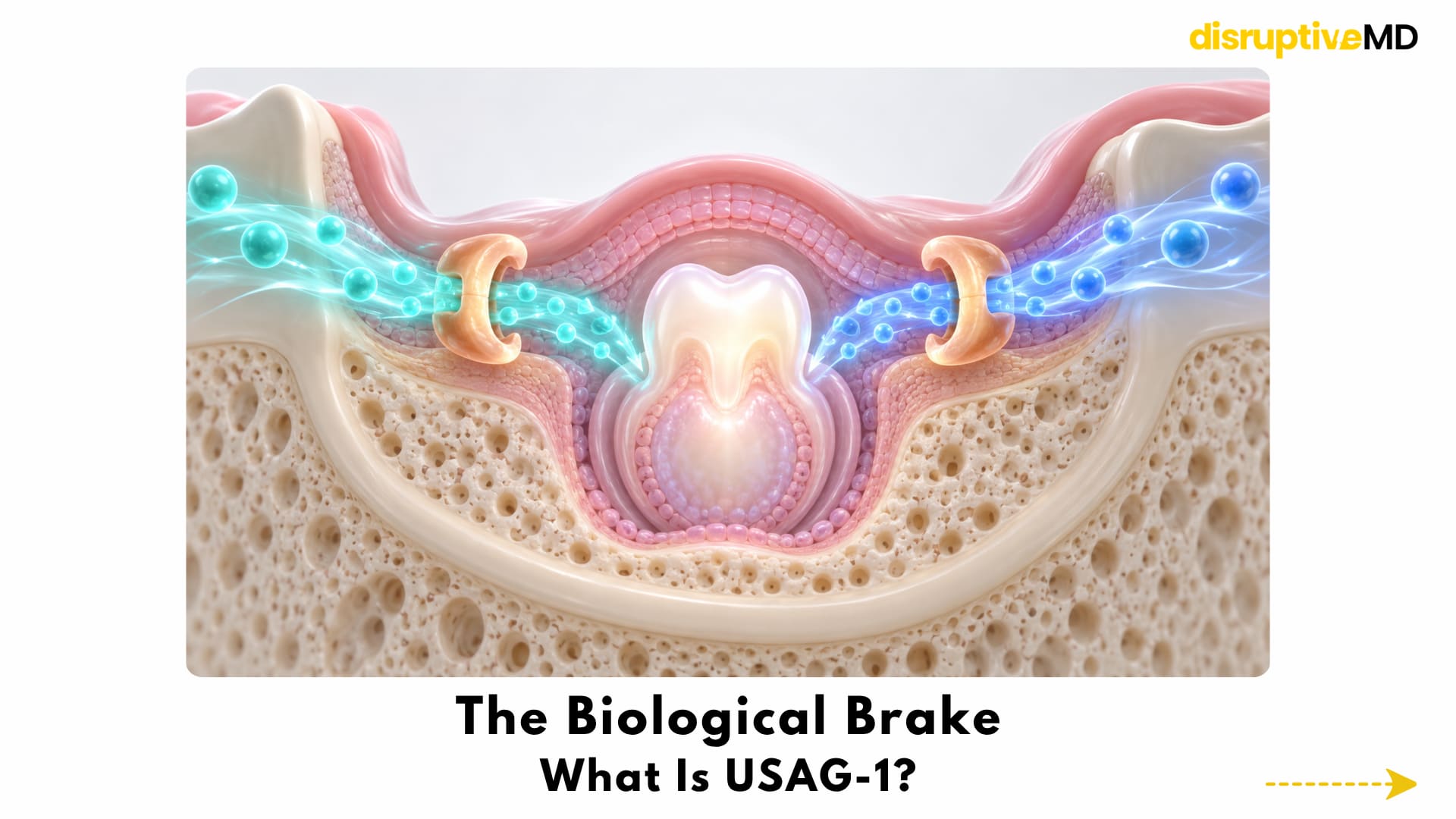
USAG-1 also known as SOSTDC1 interacts with these pathways and acts as an inhibitory regulator.
Researchers noticed something intriguing in experimental animals:
when USAG-1 function was lost, animals could develop supernumerary teeth extra teeth beyond the usual number.
That observation led to a compelling hypothesis.
If USAG-1 helps suppress tooth formation, perhaps temporarily blocking it could remove a developmental brake.
Instead of trying to construct a tooth piece by piece, the treatment could allow biological structures already programmed for tooth development to continue growing.
The concept can be simplified to:
USAG-1 active → developmental signal restrained
USAG-1 blocked → developmental potential released
That simplification does not capture the full molecular complexity, but it explains why USAG-1 became such an interesting therapeutic target.
In experimental work, blocking USAG-1 function with neutralizing antibodies rescued congenital tooth agenesis caused by several genetic abnormalities in mice. The researchers concluded that USAG-1 helps control tooth number by inhibiting the development of potential tooth germs.
And that changes the question completely.
The drug may not need to manufacture a tooth from nothing.
It may instead need to unlock a tooth-development program that has been suppressed.
3. THE ANIMAL EXPERIMENT THAT CHANGED THE CONVERSATION
The research became particularly exciting when antibody treatment produced actual changes in tooth formation.
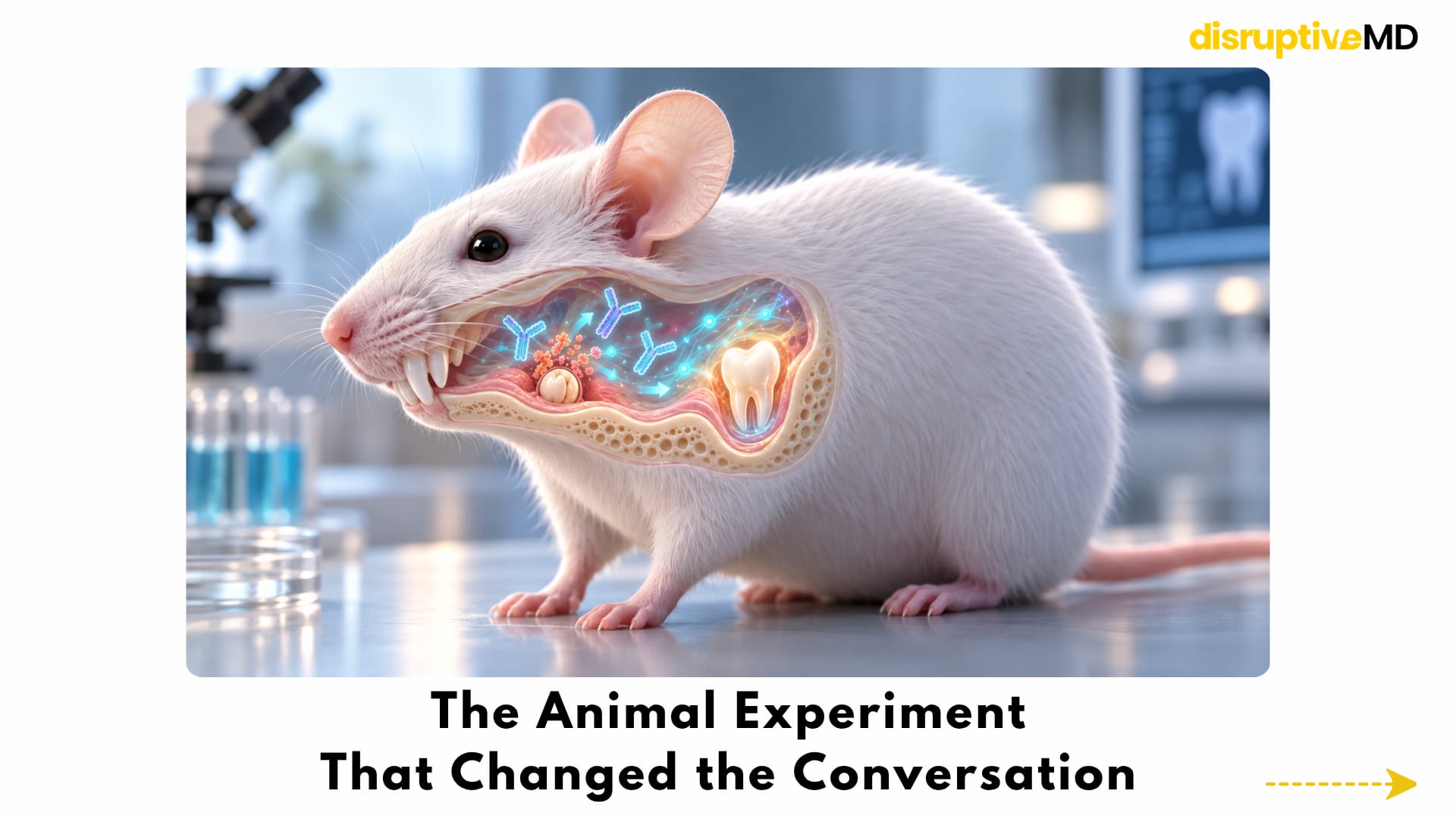
In a landmark 2021 study, researchers tested antibodies targeting USAG-1 in mouse models of congenital tooth agenesis.
Blocking USAG-1 relieved arrested tooth development in several genetic models.
The study linked this effect particularly to altered BMP signalling and demonstrated that interfering with the USAG-1 pathway could change tooth number.
Separate experimental work using Usag-1 siRNA a different strategy designed to reduce expression of the same biological target—also partially rescued arrested tooth development in a mouse model.
The importance of these studies goes beyond simply producing extra teeth in mice.
They suggested that tooth agenesis might sometimes represent a developmentally arrested state rather than an irreversible absence of regenerative potential.
If a suppressed tooth germ can be pushed back into development, congenital tooth absence might eventually become treatable using molecular medicine.
Later translational research progressed toward larger animal models and eventually a humanized antibody candidate. A 2024 review of the development program described the creation of a humanized anti-USAG-1 antibody intended for clinical development in congenital tooth agenesis.
That candidate became:
TRG035.
4. TRG035: A DRUG DESIGNED TO MAKE TEETH GROW?
The phrase “tooth-regrowth drug” sounds almost unbelievable.
But TRG035 is not intended to function like a conventional dental material.
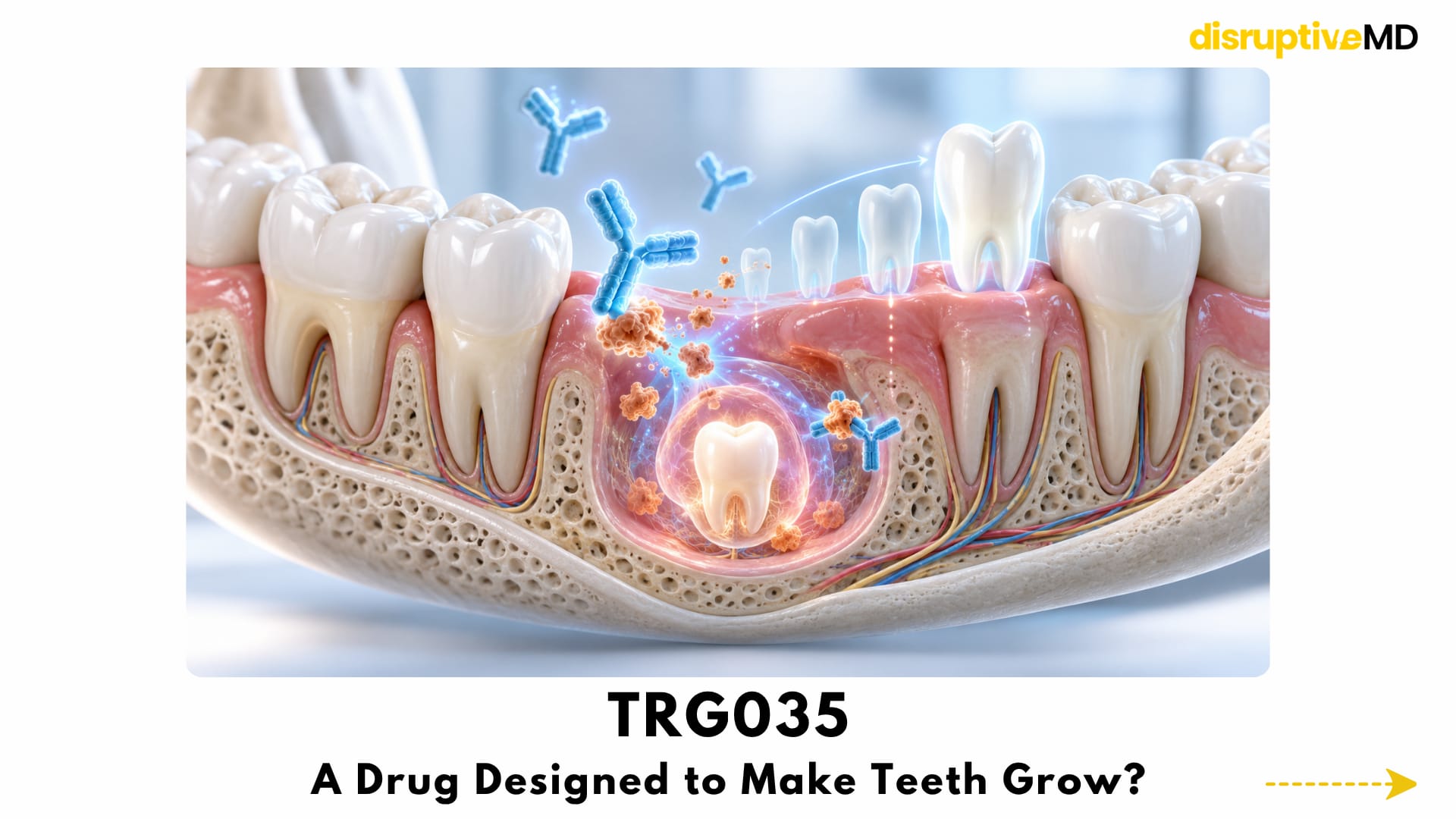
It is a humanized monoclonal antibody targeting USAG-1.
The idea is that blocking USAG-1 could alter the biological environment surrounding potential tooth germs and permit tooth development to proceed.
That makes this a form of molecularly targeted regenerative medicine.
Instead of supplying the final replacement structure, the drug attempts to alter the signalling network controlling organ development.
That distinction matters.
There are several possible ways to regenerate a tooth.
One approach might involve:
cells → scaffold → engineered tooth → transplantation
The anti-USAG-1 concept is closer to:
drug → developmental pathway changes → endogenous tooth formation
If successful, this could dramatically simplify biological tooth replacement.
But it also creates important questions.
Can doctors control how many teeth develop?
Can they determine where they develop?
Will the new tooth have the correct shape?
Will the crown orient correctly?
Will its roots form normally?
Will it erupt into the correct position?
Will it establish a functional periodontal ligament?
Will its bite relationship be appropriate?
Could unintended teeth form?
And how durable would the result be over decades?
Growing a tooth is only the first challenge.
Clinical dentistry ultimately needs to grow the right tooth, in the right place, with the right anatomy.
5. WHY THE FIRST PATIENTS ARE NOT PEOPLE WHO LOST A TOOTH TO DECAY
This is probably the most important distinction in the entire story.
The current clinical program is focused primarily on congenital tooth agenesis.
That means patients who were born without certain permanent teeth because those teeth failed to develop normally.
Severe forms can involve multiple missing permanent teeth.
This is very different from losing a tooth because of:
- Dental decay,
- Periodontal disease,
- Trauma,
- Failed root-canal treatment,
- Fracture,
- Extraction,
- Or ageing.
Why does that matter?
Because congenital tooth agenesis may still involve arrested developmental structures.
Experimental anti-USAG-1 research suggests that certain tooth germs that stopped developing may potentially be rescued by changing their developmental signalling environment.
Compare that with an adult who lost a molar 20 years ago.
The original tooth germ is long gone.
The socket has healed.
The alveolar bone may have remodelled.
Soft tissues have changed.
Adjacent teeth may have shifted.
The developmental environment that produced the original tooth disappeared decades earlier.
That makes the claim:
“We may be able to stimulate congenitally arrested tooth development”
very different from:
“We can regrow any adult tooth that has been extracted.”
The first is now being clinically investigated.
The second remains a much more ambitious future possibility.
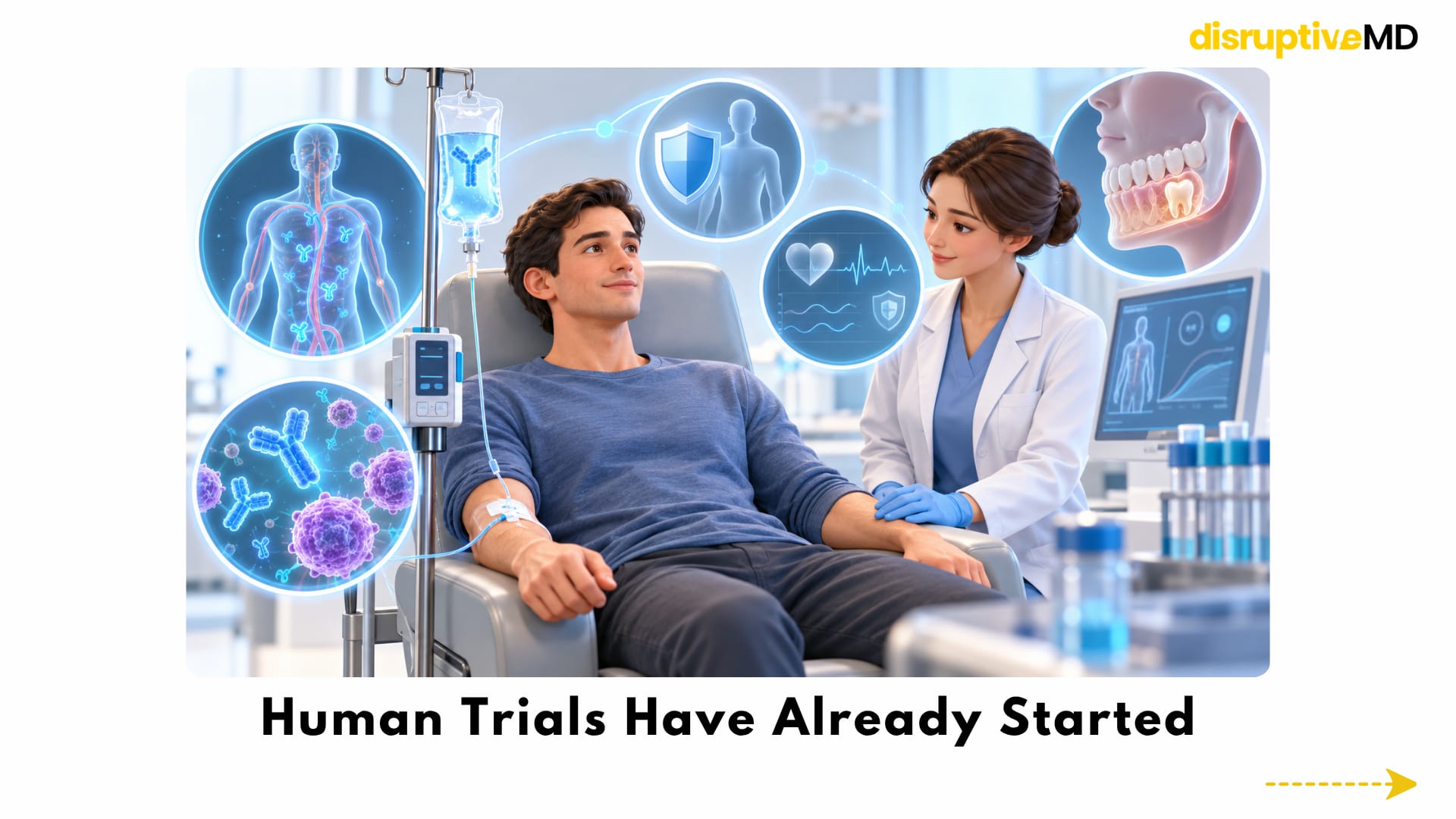
6. HUMAN TRIALS HAVE ALREADY STARTED
The most significant transition has now happened:
TRG035 has moved from animal models into humans.
Japan’s official clinical-trial registry lists a Phase I single-administration study of TRG035 in healthy adults.
The trial was:
- Randomized,
- Double-blind,
- Placebo-controlled,
- Dose-escalating,
- Based on a single intravenous administration,
- And designed for a target sample size of 30 participants.
The registry now lists recruitment as complete.
That is a major development.
But it is essential to understand what the trial was actually testing.
The primary outcome was safety.
Secondary outcomes included:
- Pharmacokinetics,
- And the frequency of antibodies against TRG035.
In other words, the study was primarily designed to answer questions such as:
Can people tolerate the drug?
How does it behave in the human body?
Does the immune system react against it?
The trial was not designed primarily to prove that a new tooth grows.
So saying:
“Human tooth-regrowth trials have happened”
is reasonable.
Saying:
“Scientists have proven they can regrow human teeth”
is not.
Those are very different statements.
7. THE NEXT BIG STEP: PHASE IIA
The next clinical stage matters far more for the central scientific claim.
Phase IIa is intended to move development closer to patients with congenital tooth agenesis and begin exploring whether the biological effect seen in animals can translate into meaningful human tooth development.
And the program has recently moved another step forward.
On August 17, 2026, the developers announced that the required regulatory investigation of the Clinical Trial Notification for an exploratory TRG035 Phase IIa trial had been completed in Japan.
That is a very current and important milestone.
But again, the distinction matters:
completion of a clinical-trial notification review is not evidence that the drug works.
It is a development and regulatory step that allows the program to move toward the clinical study designed to investigate that question.
As of August 2026, publicly available clinical information still does not establish that TRG035 can reliably generate a functional new human tooth.
The Phase II era is therefore where the story becomes particularly important.
This is where researchers need to move from:
Animal biological proof-of-concept
to:
Human therapeutic efficacy.
8. WHY CHILDREN COULD BE CRITICAL
The proposed patient population makes developmental sense.
Children with congenital missing teeth are fundamentally different from adults who have lost teeth after decades of use. Their jaws are still developing.
Their permanent dentition is still part of an active developmental environment.
And depending on the underlying cause, some potential tooth structures may be arrested rather than completely absent.
Earlier clinical-development plans identified young children with multiple congenitally absent teeth as an intended population for Phase IIa investigation.
This is one reason the programme has attracted so much interest.
If a drug could restart a tooth-development process during childhood, it might offer something conventional dental prosthetics cannot:
Development of the patient’s own biological tooth while the jaw itself is still growing.
That could be especially meaningful because implants are complicated in growing children.
An implant behaves very differently from a natural tooth during craniofacial growth.
A naturally developing tooth, by contrast, participates in the changing anatomy of the jaw.
But there is also a higher safety bar.
Modifying developmental pathways in children requires extraordinary caution.
Researchers will need to establish not only whether tooth formation occurs, but whether it occurs predictably, locally and safely.
9. GROWING A TOOTH IS NOT ENOUGH
Suppose a future Phase II trial produces a new mineralized structure on imaging.
That would be scientifically exciting.
But from a clinical perspective, it would only be the beginning.
A genuinely successful regenerated tooth would ideally need to satisfy several conditions.
Correct location
A new tooth forming in the wrong part of the jaw could create more problems than it solves.
Correct number
The therapy must avoid uncontrolled formation of multiple supernumerary teeth.
Correct shape
A molar needs a different anatomy from an incisor.
Dental function depends heavily on crown morphology.
Correct eruption
The tooth must move through bone and soft tissue into the oral cavity in a clinically useful position.
Normal root development
Roots must form sufficiently to provide stability.
Periodontal integration
Natural teeth are suspended within the jaw by the periodontal ligament.
This tissue participates in mechanical sensing, load transfer and bone remodelling.
Pulp and neural function
A truly biological tooth should ideally include viable internal tissues and normal biological responses.
Occlusion
The tooth eventually has to meet the opposing dentition correctly.
A perfectly regenerated tooth positioned badly could still require orthodontic treatment.
Long-term stability
A tooth that forms successfully must continue functioning for years or decades.
These questions explain why regenerative dentistry is so much more complicated than simply making enamel appear.
The challenge is not:
Can biology produce dental tissue?
We already know it can.
The challenge is:
Can medicine reliably control an entire organ-development program?
10. THE THIRD DENTITION: DO HUMANS HAVE “BACKUP” TEETH?
One of the most futuristic ideas surrounding this field is the possibility of a third dentition.
Humans normally develop two sets of teeth:
Primary teeth → permanent teeth
But developmental remnants associated with additional potential tooth formation have led researchers to investigate whether humans may retain biological capacity beyond those two conventional dentitions.
The idea is fascinating:
perhaps certain latent tooth structures are normally suppressed rather than completely absent.
If those structures could be safely activated, regeneration after tooth loss might become possible even beyond congenital agenesis.
The anti-USAG-1 development programme has discussed future expansion toward acquired tooth loss and activation of potential “third teeth.”
But this remains one of the biggest leaps between the current evidence and the futuristic vision.
Treating congenital tooth agenesis and regenerating an extracted adult tooth are not equivalent biological problems.
The latter may require:
- Identifying suitable residual tooth-forming structures,
- Recreating a developmental niche,
- Controlling tooth identity,
- Controlling eruption,
- Managing adult bone anatomy,
- And determining whether sufficient regenerative potential still exists.
So the third-dentition concept is scientifically intriguing.
It is not yet routine regenerative dentistry.
11. COULD A 60-YEAR-OLD SOMEDAY REGROW A MOLAR?
This is the question most people ultimately care about.
Imagine a patient loses a molar from periodontal disease.
Today the options might include:
- Leaving the space,
- A removable prosthesis,
- A bridge,
- Or an implant.
A truly disruptive future would add another possibility:
regenerate a new biological tooth.
But this is much harder than treating a developmentally missing tooth in a child.
Adult tooth loss creates multiple biological problems.
The original tooth is gone.
The surrounding bone remodels.
The periodontal ligament disappears.
The local anatomy changes.
The space may shrink.
And the developmental signals required to build a tooth are no longer naturally active.
A future adult regenerative treatment might therefore require much more than one systemic antibody.
It could involve combinations of:
Developmental signalling + stem cells + biomaterials + spatial drug delivery + imaging + orthodontic guidance.
The first-generation therapy may therefore not be the final form of regenerative dentistry.
TRG035 may instead prove something even more important:
That tooth number can potentially be manipulated pharmacologically in humans.
If that principle is established, an entire field could build around it.
12. THE 2030 VISION
A target that frequently appears in discussions of this research is 2030.
Published development information has described an ambition to make a tooth-regeneration therapy available to patients around 2030.
That makes a compelling headline.
But it needs careful interpretation.
2030 is a development goal, not a guaranteed clinical launch date.
Drug development depends on multiple stages succeeding:
Phase II must demonstrate meaningful efficacy.
Safety must remain acceptable.
The correct dose must be established.
Any developmental abnormalities must be identified.
Manufacturing must remain reliable.
Later clinical studies may be required.
Regulatory authorities must judge the overall benefit-risk profile acceptable.
And even if a therapy receives approval, its first indication could remain narrow.
For example:
severe congenital tooth agenesis
is very different from:
any person who has ever lost a tooth.
So a successful launch near the end of this decade would be historically important.
But dentures and implants would not suddenly disappear.
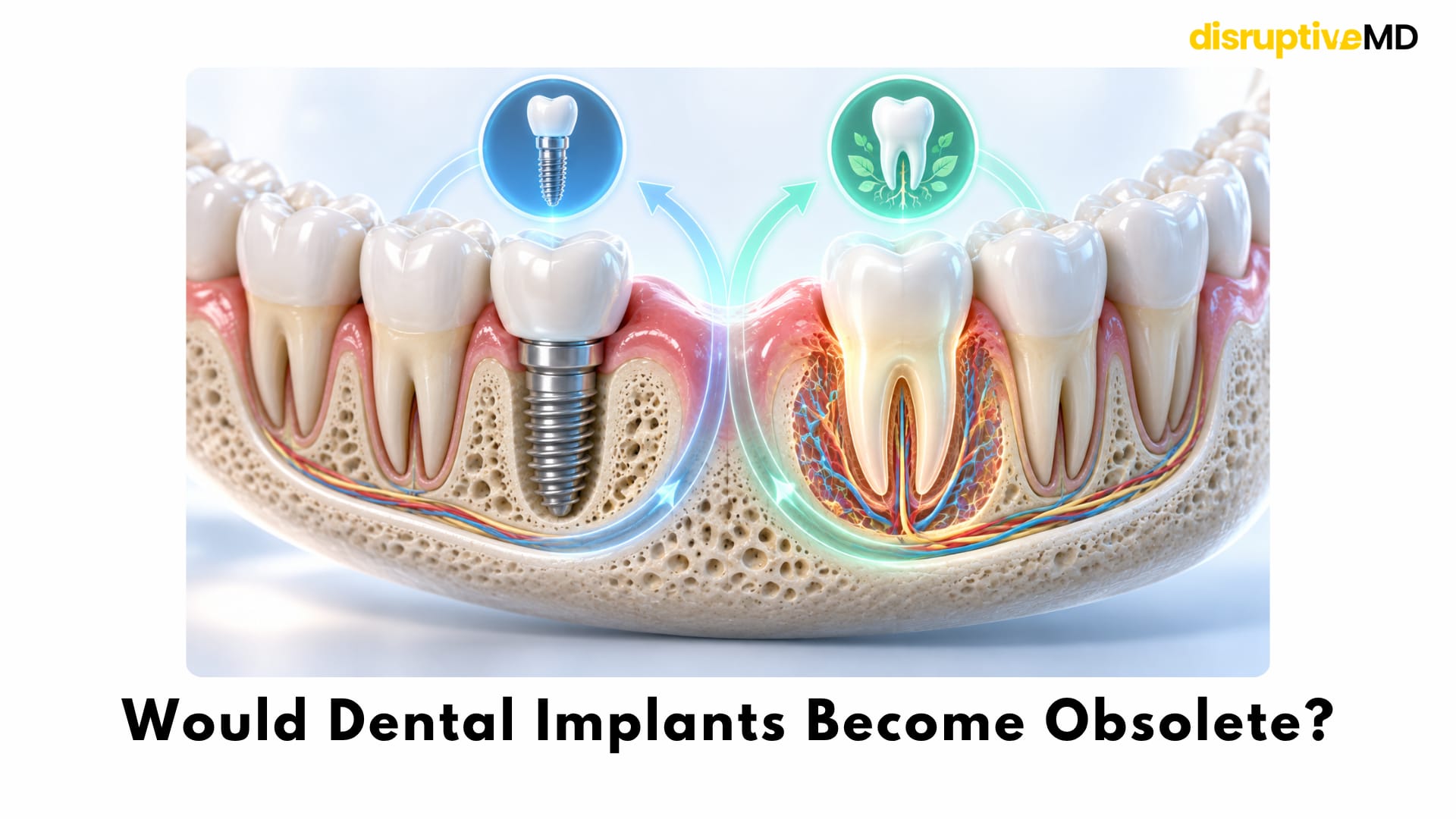
13. WOULD DENTAL IMPLANTS BECOME OBSOLETE?
Probably not.
At least not for a very long time.
Dental implants are mature, highly developed technologies with predictable clinical applications.
Even if tooth regeneration becomes possible, some patients may still require implants because of:
- Age,
- Severe bone loss,
- Medical contraindications,
- Absence of regenerative potential,
- Previous surgery,
- Complex anatomy,
- Need for rapid restoration,
- Or failed regenerative treatment.
There may also be situations where an artificial replacement is simply more predictable.
The future may therefore not be:
Regeneration replaces implants.
It may be:
Regeneration becomes another option alongside implants.
That alone would be revolutionary.
Dentistry currently asks:
Can this tooth be saved?
If not:
How should we replace it?
A regenerative future could introduce a third question:
Can another biological tooth be generated?
That would change treatment planning fundamentally.
14. BEYOND TRG035: THE TOOTH-REGENERATION TOOLBOX
Even if anti-USAG-1 therapy becomes successful, it is unlikely to be the only technology shaping regenerative dentistry.
Several parallel approaches are developing.
Antibody drugs
Molecular therapies could selectively block inhibitory proteins or enhance pathways that encourage endogenous tooth development.
The advantage is potentially enormous:
no major cell transplantation procedure may be necessary.
Stem-cell biology
Stem cells remain central to many regenerative approaches because teeth contain several specialized tissues that arise from different cellular populations.
Future strategies could use:
- Dental pulp stem cells,
- Periodontal stem cells,
- Induced pluripotent stem cells,
- Epithelial progenitors,
- Or engineered cell combinations.
Tooth-germ engineering
Animal experiments have already demonstrated that bioengineered tooth germs can generate functional tooth structures after transplantation.
The challenge is translating that process into something safe, reproducible and scalable for humans.
3D scaffolds and biomaterials
Future scaffolds could guide cells into appropriate three-dimensional structures.
Instead of simply filling a defect, biomaterials may eventually carry:
- Developmental signals,
- Growth factors,
- Progenitor cells,
- Vascular cues,
- Or timed-release therapeutics.
Dental organoids
Organoids are miniature three-dimensional biological structures grown from cells to reproduce aspects of organ development.
Dental organoids could become valuable for:
- studying human tooth development,
- investigating congenital defects,
- testing regenerative drugs,
- modelling patient-specific biology,
- and potentially generating tissues for future reconstruction.
Regenerative implants
The implant of the future may itself become more biological.
Animal studies have explored hybrid dental implants designed to interact more naturally with periodontal tissues.
So the future may not necessarily be a competition between:
Implant OR regenerated tooth.
Hybrid systems could blur that boundary.
AI-GUIDED DENTAL DEVELOPMENT
AI could eventually become particularly useful because regenerative dentistry creates a spatial-planning problem.
A clinician may need to predict:
- Whether a patient has regenerative potential,
- Where a tooth germ exists,
- What direction a tooth is developing,
- Whether adjacent structures are at risk,
- Whether eruption is occurring normally,
- And whether orthodontic intervention will be required.
Advanced imaging combined with machine learning could eventually create personalised maps of regenerative potential within the jaw.
15. REGENERATIVE DENTISTRY COULD BECOME PRECISION MEDICINE
Not every patient will respond equally.
Congenital tooth agenesis can result from different genetic abnormalities.
Different patients may have tooth development arrested at different stages.
One patient may retain a viable tooth germ.
Another may not.
One molecular pathway may dominate in one genetic condition but be less important in another.
This means tooth regeneration could eventually require biomarker-driven patient selection.
A future diagnostic work-up might combine:
- Genetic sequencing,
- Dental imaging,
- Developmental history,
- 3D jaw anatomy,
- Biological markers,
- And predictive algorithms.
The question would no longer simply be:
“Which tooth is missing?”
It could become:
“Why is this tooth missing, what developmental potential remains, and which regenerative pathway should be activated?”
A 2023 review of tooth agenesis and regeneration specifically highlighted the potential importance of genetic, imaging and molecular biomarkers for identifying patients most likely to benefit from regenerative therapies.
That is where regenerative dentistry begins to intersect with precision medicine.
16. WHAT IS REAL TODAY?
There is already substantial science behind this field.
USAG-1 is a real developmental target
Experimental research has demonstrated that USAG-1 participates in regulating pathways involved in tooth formation.
Blocking USAG-1 can affect tooth development in animals
Anti-USAG-1 antibody treatment has rescued congenital tooth agenesis in mouse models.
Other methods of reducing USAG-1 signalling have also shown effects
Local Usag-1 siRNA partially rescued arrested tooth development in a mouse model.
Whole functional teeth have been bioengineered in animal models
Separate tissue-engineering experiments demonstrated erupted and functionally integrated bioengineered teeth in mice.
A humanized anti-USAG-1 antibody has been developed
TRG035 represents the clinical candidate emerging from this research programme.
Phase I human development is real
The registered Phase I trial enrolled a target of 30 adult participants and is listed as complete.
The programme is moving toward Phase IIa
On August 17, 2026, the required investigation of the Phase IIa Clinical Trial Notification was reported complete, marking another step toward efficacy-focused investigation in congenital tooth agenesis.
The first clinical target is congenital missing teeth
This is not currently a general treatment for every form of adult tooth loss.
17. WHAT IS NOT FULLY REAL YET?
The excitement surrounding tooth regeneration needs equally clear boundaries.
There is no approved routine tooth-regrowth drug
Patients cannot currently visit a dental clinic and receive an injection that predictably grows a new tooth.
Human efficacy has not yet been proven
Completion of Phase I does not establish that TRG035 produces clinically useful new teeth.
Phase IIa preparation is not the same as successful Phase II results
The August 2026 regulatory milestone allows development to progress, but it does not demonstrate efficacy.
Regrowth after ordinary adult tooth loss is not established
There is currently no clinical proof that a tooth lost from decay, periodontal disease, trauma or extraction can simply be regrown with anti-USAG-1 treatment.
Scientists cannot yet reliably choose the exact anatomy of a regenerated tooth
Predictable control over:
- Shape,
- Size,
- Location,
- Eruption,
- Root development,
- And occlusion
remains a major translational challenge.
Implants are not about to disappear
Dental implants remain an established therapy with decades of clinical development behind them.
2030 is not a guaranteed approval date
It is an ambitious development target dependent on successful clinical trials and regulatory review.
18. WHY THIS IS BIGGER THAN DENTISTRY
This may look like a story about dentures.
It is really a story about regenerative medicine.
A conventional implant says:
The biological structure is gone build an artificial replacement.
Regenerative medicine asks:
Can we reactivate the programme that created that structure in the first place?
That question extends far beyond teeth.
Scientists are asking related questions across medicine:
Can cartilage be made to regenerate instead of scar?
Can damaged heart tissue regain functional muscle?
Can injured nerves reconnect?
Can diseased organs reactivate developmental repair mechanisms?
Can ageing tissues recover lost regenerative capacity?
Can medicines manipulate development without creating uncontrolled growth?
Teeth provide a particularly fascinating test case because the outcome is so visible.
If a completely new natural tooth can be pharmacologically generated in a human jaw, there will be very little ambiguity about whether regenerative medicine has achieved something profound.
You will be able to see it.
Image it.
Watch it erupt.
And eventually ask whether it can chew.
That makes tooth regeneration one of the most tangible demonstrations of what developmental medicine could eventually become.
KEY TAKEAWAY
Tooth regeneration is no longer purely a laboratory idea.
Scientists have identified developmental pathways capable of changing tooth formation, anti-USAG-1 treatment has produced compelling effects in animal models, and a humanized antibody designed around that mechanism has progressed into human clinical development.
The Phase I study is now listed as complete, and as of August 17, 2026, the development programme has also reported completion of the required regulatory investigation for its planned exploratory Phase IIa trial.
But the most important breakthrough has not happened yet:
Predictable human tooth-regrowth efficacy has not been demonstrated.
The initial clinical target is congenital tooth agenesis—not the routine replacement of adult teeth lost from decay, periodontal disease, trauma or ageing.
And even successful tooth formation will not be enough.
A regenerated tooth must ultimately develop in the correct position, produce appropriate anatomy, form roots, integrate with surrounding tissues, erupt predictably and function within the patient’s bite.
So dentures and implants are not becoming obsolete today.
But dentistry may be approaching something it has never really had before:
A third option beyond repairing a tooth or replacing it regenerating it.
If human efficacy can eventually be demonstrated, dentistry could begin moving from prosthetic replacement toward biological restoration.
And that would make tooth regeneration much more than a dental breakthrough.
It would demonstrate something medicine has pursued for decades:
Instead of only replacing what the human body has lost, perhaps we can learn how to make the body build it again.
FACT BASE
The most balanced interpretation of the current evidence is:
Tooth regeneration is biologically credible and anti-USAG-1 treatment has demonstrated strong preclinical proof-of-concept, but therapeutic regeneration of a functional human tooth has not yet been proven.
1. USAG-1 has strong biological rationale
USAG-1 interacts with BMP and Wnt signalling pathways involved in tooth development. Experimental USAG-1 deficiency is associated with supernumerary tooth formation, supporting its role as an important regulator of tooth number.
2. Anti-USAG-1 antibodies have worked in animal models
A 2021 study demonstrated that blocking USAG-1 with neutralizing antibodies could alleviate congenital tooth agenesis caused by several genetic abnormalities in mice. The work provided the central preclinical proof-of-concept for an antibody-based regenerative approach.
3. Independent manipulation of the same target supports the concept
Local inhibition of Usag-1 using siRNA also partially rescued arrested tooth development in a mouse congenital tooth-agenesis model, providing additional support for the biological target.
4. Whole-tooth regeneration itself is biologically possible in animals
Earlier tissue-engineering studies produced bioengineered teeth that erupted, reached occlusion and demonstrated functional characteristics in adult mouse models. These experiments used a very different methodology but established that complex functional tooth structures can be regenerated experimentally.
5. TRG035 is a genuine clinical-stage candidate
A humanized anti-USAG-1 antibody was developed specifically as a candidate treatment for congenital tooth agenesis.
6. The first human trial is complete
The official Japanese clinical-trial registry lists the Phase I single-administration study of TRG035 as complete, with a target sample size of 30 adults. The primary endpoint was safety; secondary endpoints included pharmacokinetics and anti-TRG035 antibody frequency.
Therefore:
Phase I completion should not be interpreted as proof of human tooth regeneration.
7. Phase IIa development has advanced
Funding announced in May 2026 was described as supporting Phase II clinical development in patients with congenital tooth agenesis.
On August 17, 2026, the developers announced completion of the required investigation of the Clinical Trial Notification for an exploratory TRG035 Phase IIa trial.
This represents an important translational milestone but still does not constitute evidence of efficacy.
8. Congenital tooth agenesis remains the central first indication
The current development pathway is focused on patients whose teeth failed to develop congenitally. Earlier clinical plans identified young children with multiple congenitally absent teeth as a major target population for Phase IIa investigation.
9. Acquired adult tooth loss remains a future ambition
Developers have discussed eventual expansion toward teeth lost through caries, periodontal disease or trauma, potentially through stimulation of a third dentition. But this is a future developmental goal—not established human therapy.
10. The 2030 timeline is aspirational
Current public development information continues to describe 2030 as the goal for delivering the therapy to patients. It should be interpreted as a target dependent on successful clinical trials, safety evaluation and regulatory approval—not as a guaranteed launch date.
The evidence position as of August 2026
Real: Anti-USAG-1 tooth regeneration in animal models. Real: A humanized antibody candidate. Real: Completed Phase I human testing. Real: Progress toward Phase IIa clinical investigation. Not yet proven: Human tooth-regrowth efficacy. Not yet proven: Predictable regeneration of teeth lost through ordinary adult dental disease or trauma. Not yet real: A routine tooth-regrowth drug replacing implants and dentures in everyday dental practice.
The most scientifically defensible conclusion is therefore:
The biology is real. The clinical programme is real. The possibility is extraordinary. But the decisive human efficacy evidence is still ahead.
REFERENCES
- Murashima-Suginami A, Kiso H, Tokita Y, et al. Anti-USAG-1 therapy for tooth regeneration through enhanced BMP signaling. Science Advances. 2021;7(7):eabf1798. DOI: 10.1126/sciadv.abf1798.
- Takahashi K, Kiso H, Mihara E, et al. Development of a new antibody drug to treat congenital tooth agenesis. Journal of Oral Biosciences. 2024;66(4):1–9. DOI: 10.1016/j.job.2024.10.002.
- Mishima S, Takahashi K, Kiso H, et al. Local application of Usag-1 siRNA can promote tooth regeneration in Runx2-deficient mice. Scientific Reports. 2021;11:13674. DOI: 10.1038/s41598-021-93256-y.
- Ravi V, Murashima-Suginami A, Kiso H, et al. Advances in tooth agenesis and tooth regeneration. Regenerative Therapy. 2023;22:160–168. DOI: 10.1016/j.reth.2023.01.004.
- Ikeda E, Morita R, Nakao K, et al. Fully functional bioengineered tooth replacement as an organ replacement therapy. Proceedings of the National Academy of Sciences of the USA. 2009;106(32):13475–13480. DOI: 10.1073/pnas.0902944106.
- Oshima M, Mizuno M, Imamura A, et al. Functional tooth regeneration using a bioengineered tooth unit as a mature organ replacement regenerative therapy. PLoS ONE. 2011;6(7):e21531. DOI: 10.1371/journal.pone.0021531.
- Oshima M, Inoue K, Nakajima K, et al. Functional tooth restoration by next-generation bio-hybrid implant as a bio-hybrid artificial organ replacement therapy. Scientific Reports. 2014;4:6044. DOI: 10.1038/srep06044.
- Phase I Single-Administration Study of TRG035 in Healthy Adults: double-blind, randomized, placebo-controlled dose-escalation study. Japan Registry of Clinical Trials. Trial ID jRCT2051240154. Recruitment status: complete; target sample size: 30; primary outcome: safety.
- Clinical development plan for TRG035 in congenital tooth agenesis. Public clinical-development information describing the first-in-human study, intended Phase IIa population and longer-term development pathway.
- Official September 2025 orphan medicinal product designation listing. TRG035 designated for severe congenital partial anodontia in Japan.
- May 19, 2026 clinical-development financing update. Funding described as supporting Phase II TRG035 trials in Japan and preparation for future international development.
- August 17, 2026 Phase IIa development update. Completion of the required investigation of the Clinical Trial Notification for an exploratory TRG035 Phase IIa trial for congenital tooth agenesis.
- Current clinical-trial planning information for tooth-regeneration therapy. Public development information continues to describe 2030 as the goal for delivering treatment to patients while noting that the planned clinical trial has not yet begun on the page’s current status.